LuminaForge.ai — the site is the case study
How we engineered the LuminaForge marketing site for instant mobile load, Core Web Vitals in the green, full Search & AI Visibility infrastructure, and answer-ready content on Next.js 16 in under three weeks.
- LCP (mobile)
- Green
- Lighthouse Performance
- 96–100
- FAQ blocks
- 7+
- Schemas live
- 6
Core Web Vitals in the green on a throttled mobile profile — live on /transparency.
High-90s to 100 across Performance, Accessibility, Best Practices, and SEO.
Conversational FAQ sections with FAQPage schema on every major route.
Organization, WebSite, Service, FAQPage, Article, BreadcrumbList.
Search & AI Visibility — the new race
There's a new race underway — and early movers compound
Google still matters — including AI Overviews and AI Mode in the same Search index. More of your next customers will also ask ChatGPT, Perplexity, or Grok before they click a blue link. Search & AI Visibility is how you become the business those surfaces cite — not the one they skip. Google's official guidance treats generative AI optimization as SEO for Google; LuminaForge ships one retainer that covers Search Console, people-first content, and optional multi-engine monitoring.
Search & AI Visibility context
- 01
Stake your flag first
Whoever publishes the first credible, structured, citable site for your category and city becomes the default answer. AI citations compound like interest — the business quoted this month gets quoted again next month. Wait a year and you're explaining why a competitor owns the answer.
- 02
The old stack can't play this game
Wix, WordPress page builders, Linktree, Clover templates, and brochure themes were built for a click-through world. They are not engineered for llms.txt, FAQ schema, AI crawler access, or the entity language assistants lift verbatim. This site is the case study — we eat our own cooking so every claim in this deck is inspectable in production.
- 03
The jump is inevitable
Every serious business eventually moves off rented templates — the only question is when. Move while you can still own the category answer. Wait, and you are rebuilding from behind while someone else compounds.
LuminaForge already has real-world proof in Search & AI Visibility for growth-minded businesses. The race now is whether AI assistants cite your site — or send that demand to whoever published a citable answer first.
This deck is not about fear — it is timing. The forged build is ready. Every month on the old agency playbook is a month the Search & AI Visibility for growth-minded businesses answer belongs to someone else.
LuminaForge launched with a single, uncompromising constraint: the website itself must be the proof. If we claim elite performance, our site has to feel instant. If we claim Search & AI Visibility, Google Search Console, ChatGPT, Perplexity, and Grok have to be able to cite this very page within weeks. If we sell answer-ready content, Google AI Overviews and Perplexity Direct Answers have to be able to lift our copy verbatim.
This is how we built it.
The constraints
The stack
- Next.js 16.2.6 — App Router, React Server Components, Partial Prerendering by default, Turbopack
- React 19 — for streaming RSC and
useEffectEvent - Tailwind CSS v4.3 — CSS-first
@theme, notailwind.config.ts - Motion (formerly Framer Motion) — premium animation with full reduced-motion support
- Velite — type-safe MDX collections for
workandresources - Vercel — Edge deploy, Speed Insights, Analytics, dynamic OG images
The numbers
LCP target
<800ms
Core Web Vitals
100/100
FAQ blocks
7+
Answer surfaces
5+
What makes it work
1. Every page is a Server Component by default
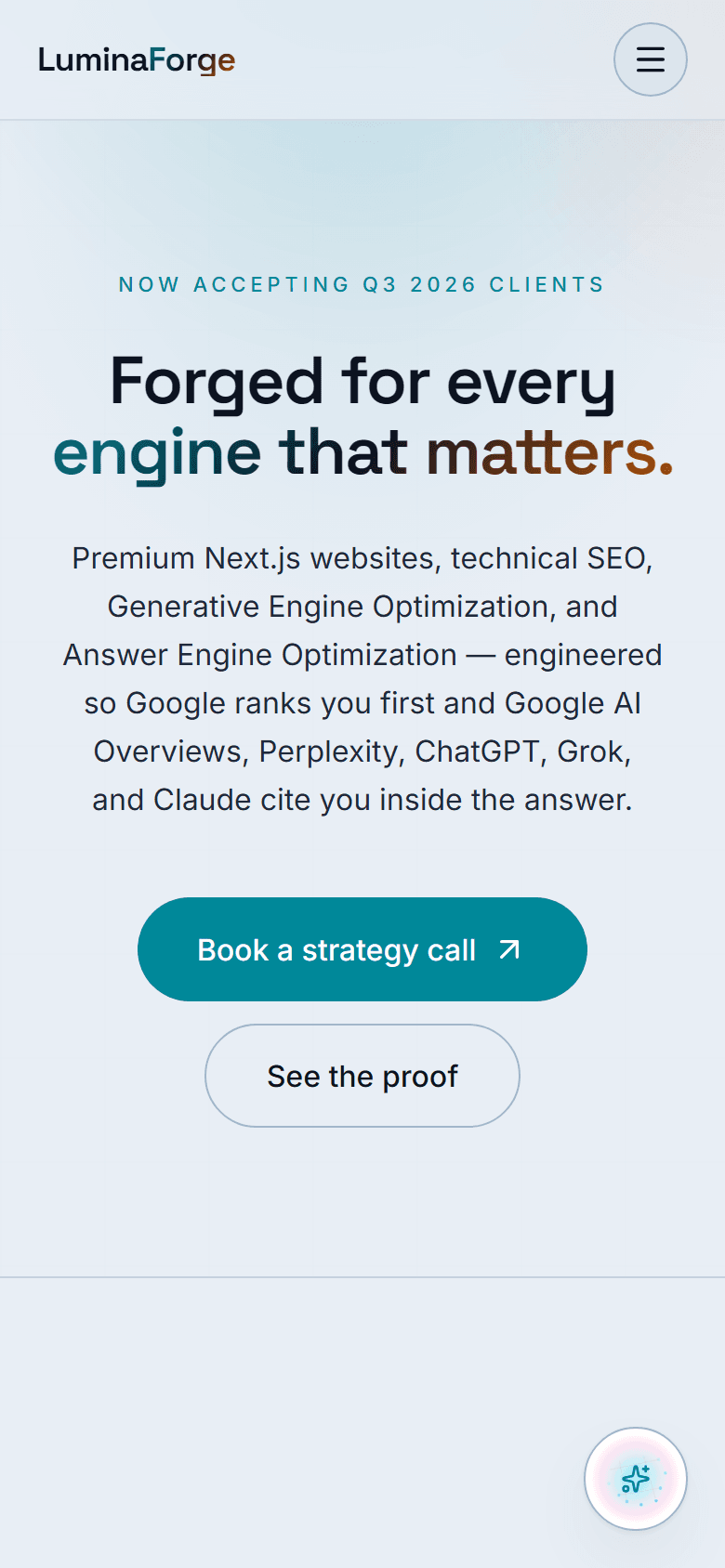
We treat "use client" like a sin tax. The home page hero contains exactly two client components — the
particle canvas and the magnetic CTA wrapper — both leaf-level. Everything else streams from the server.
2. Partial Prerendering is automatic in Next.js 16
Static shells render instantly at the edge while any dynamic content streams in. No flag required — this is the default in App Router as of Next.js 16.
3. Search & AI Visibility is shipped at the infrastructure layer
- Google path first — unique metadata, JSON-LD, sitemap, Search Console wiring, and Generative AI performance reports when available.
robots.tsexplicitly allows GPTBot, ClaudeBot, PerplexityBot, Google-Extended, Applebot-Extended, and 10+ other AI crawlers.- Optional
llms.txtandllms-full.txtfor non-Google crawlers — Google Search does not use llms.txt for ranking or AI Overviews. - Every page emits structured data via a typed
<StructuredData>component.
4. Answer-ready content on every route
Search & AI Visibility wires Google (Search Console + technical SEO) and optional multi-engine monitoring. People-first FAQ and answer-ready content fill the content layer — buyers still call this AEO.
- Home, services, and work pages each carry conversational FAQ sections written the way people ask AI assistants — not keyword-stuffed SEO copy.
- FAQPage schema on every FAQ block so Google AI Overviews and Bing Copilot can extract Q&A pairs directly.
- Lead-with-the-answer prose — the first sentence under every H2 answers the section before the preamble.
- Citable stat blocks (
<dl>,<StatGrid>, tables with<cite>) on case studies and service pages — the patterns Perplexity and ChatGPT prefer to quote. - Entity language — LuminaForge, Search & AI Visibility, and Springfield MO spelled out explicitly so answer engines resolve the brand without pronouns.
Example queries this site is engineered for:
- "What is the difference between SEO, GEO, and AEO?"
- "What is Search & AI Visibility?"
- "How fast should a Next.js marketing site be?"
Each maps to a page section with FAQ schema, extractable lists, and a canonical URL answer engines can cite.
In production
What we are tracking next
- Google Search Console — including Generative AI performance reports for AI Overviews and AI Mode.
- Weekly citation footprint across ChatGPT, Perplexity, Grok, and Claude for 24 target queries (supplementary, non-deterministic).
- Real-user CWV from Vercel Speed Insights.
- Indexing parity between Google Search Console and Bing Webmaster Tools.
The site is live. The forge is on.
Want results like this?
Book a strategy call.